
Florida Manufactured Home Financing • NMLS #303217
Florida Mobile & Manufactured Home Loans — The Complete Guide
FHA, VA, USDA, and conventional financing for manufactured homes on land — including singlewides most lenders refuse.

Singlewides, doublewides, triplewides — primary, second home, and investment property options. We finance manufactured homes from the Florida Keys to the panhandle, including coastal properties. Conventional, FHA, VA, USDA, and Non-QM all on the table.
New · September 2, 2026
Freddie Mac now allows conventional financing on manufactured homes that have been moved from another site, with an engineer’s structural inspection. Until now only VA allowed it. If you financed a moved home through a specialty lender at a high rate, you can now refinance. Read what changed or see the moved-home page.
$0 Down Options
USDA financing now allows existing manufactured homes (under 20 years old) with zero down. VA financing is $0 down for veterans.
Singles, Doubles & Triples
We finance singlewides as primary residences, doublewides as second homes, and triplewides — coast to coast.
500s+ FICO with FHA
FHA financing can work with credit scores in the 500s, provided no mortgage or rent late payments in the last 12 months.
Manufactured Home Loan Program Comparison
The right loan program for your manufactured home depends on whether you’re a veteran, where the home is located, your credit score, and how much down payment you have. Here’s a head-to-head comparison of the five programs we offer:
| Feature | Conventional | FHA | VA | USDA | Non-QM |
|---|---|---|---|---|---|
| Min Down (Primary) | 5% | 3.5% | $0 | $0 | 20%+ |
| Min Down (Second Home) | 10% (doublewide+) | Not allowed | Not applicable | Not allowed | 20%+ |
| Min Down (Investment) | Not allowed | Not allowed | Not allowed | Not allowed | 35% |
| Cash-Out Max LTV | 65% | 80% | Up to 100% | Not typical | Varies |
| Engineer Report | Only if porches/roofline changes | Always required | Not required | Required | Lender-dependent |
| Singlewide Eligible | Primary only | Primary only | Yes | Yes | Limited |
| Moved Home OK? | Yes — Freddie Mac, as of 9/2/2026 | No | Yes — once | No | Yes (max 65% LTV) |
| Min Loan Term | 30 yrs | 30 yrs | 30 yrs | 30 yrs | 30 yrs |
| Loan Limit | Conventional limit | FHA county limit | No limit | USDA limit | Up to ~$3M |
| Min FICO | 620 | 500s possible | 580 | 640 | 660+ |
| Income Limits? | No | No | No | Yes — by county | No |
Quick read: VA is the most flexible — $0 down, no engineer report, moved homes allowed. Conventional now allows moved homes too (Freddie Mac, effective September 2, 2026). FHA goes the lowest on credit and offers the best cash-out at 80% LTV. USDA is your $0-down option if you’re under 20 years old on the home and within USDA county/income limits. Conventional is the strictest on condition but most flexible on second-home use. Non-QM is the only path to investment property on a manufactured home.
Mobile Home vs. Manufactured Home — What’s the Difference?
First thing’s first: technically a mobile home is a factory-built home that was constructed prior to June 15, 1976 and does not have HUD plates. Even so, people still today call newer manufactured homes mobile homes. The terms people use can change depending on where you live, but in Florida people often use the term mobile home for manufactured homes constructed after June 15, 1976.
A manufactured home is a factory-built home constructed to the HUD (Housing & Urban Development) Title 6 construction standards that took effect after June 15, 1976. If it is a manufactured home built to HUD code, there will be two forms of verification: a certification label and a data plate. The data plate will be located somewhere inside the home, often near an electrical box. Its placement is supposed to be easily visible.
You can find the certification label on the tail end of each transportable section of the manufactured home. You may be missing a certification label, or you may not be able to find the data plates — but one of those items is needed to verify the home is built to HUD code.
Whether you want to purchase or refinance a manufactured home, there are some nuances to financing that you need to understand. We do not finance homes on leased land or in co-ops (cooperatives). On leased land, it’s considered a chattel loan — much like a motor vehicle loan. If you plan on owning the land, then we can help you. A homeowners association is fine; condo associations are okay as long as there are no singlewides in the community.
How Important Is the Certification Label or HUD Plate?
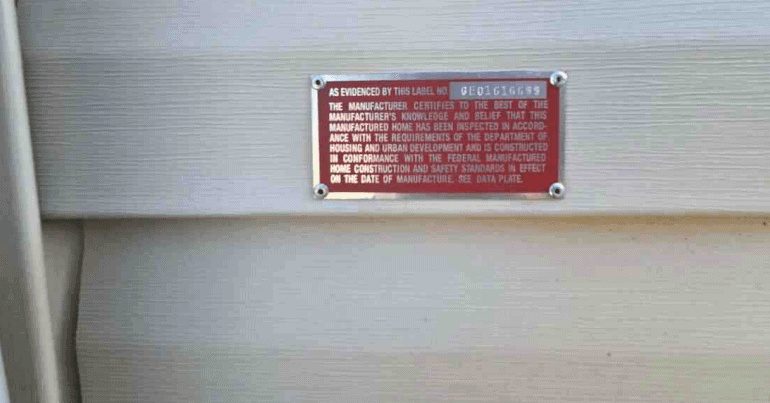
It’s actually against the law to remove HUD plates. The appraiser will need to find them when purchasing a manufactured home. HUD states that if the certification label or HUD tag is missing, they do not reissue labels. They can, however, issue a Letter of Label Verification if the data plates can’t be found.
The home should have serial numbers on a certification label that can be found inside the home in one of three spots: in a kitchen cabinet, in a bedroom closet, or on/near the main electrical panel. The data plate will have a map of the U.S. to let the consumer know the wind zone, snow load, and roof load for which their manufactured home was constructed.
When an appraisal is done for a purchase or refinance, the appraiser will look for all the necessary information — so don’t feel overwhelmed. This is an example of a HUD plate photo taken by an appraiser on the outside of the home. If there’s an issue, the lender will take the necessary action to resolve it. It’s possible to request a Letter of Label Verification from the Institute for Building Technology and Safety (IBTS) — phone (703) 481-2010 or fax (703) 437-6894.
Does My Manufactured Home’s Title Need to Be Retired?
The title to your manufactured home (which is much like a motor vehicle title) must be retired. This means the home becomes part of the land it sits on — it essentially becomes one with the title of the land. Some lenders require this to be done before closing.
Tie Downs and HUD Guidelines
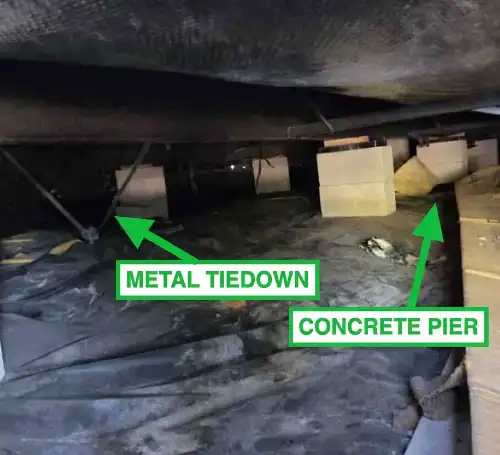
Tie downs being up to current code are one of the biggest issues we run into when borrowers buy a manufactured home. As of October 20, 2008, the Model Manufactured Home Installation Standards were implemented. This increased the size requirement for the knuckle on the tie downs that anchors the manufactured home to the ground. They also changed the requirement for the amount of longitudinal and lateral tie downs needed to meet code.
This means that if the manufactured home was anchored before October 2008, there’s a good chance the tie downs will not be up to current code. When you purchase a manufactured home, an engineer report is required to make sure it’s up to code. The only time an engineer report is not required is when conventional financing is being utilized on a home with no additions or changes to the roofline or added decking. Additionally, with FHA financing, the appraiser is going to look at the backing of the siding to make sure it’s supported.
Here is a picture detailing what the engineer will look at when they check the crawl space of the manufactured home. An adequate amount of tiedowns anchored properly, and stable concrete piers.
Do I Need an Engineer Report?
Most likely yes — unless you’re using VA financing, or you’re using a conventional loan and the home has no porches and no changes to the roofline (just steps going into the house). If using FHA, USDA, or conventional financing on a home that has porches or roofline adjustments, you’ll need an engineer report. If the property has changed hands since 2008 and the purchaser used financing, then it’s likely the tie downs have been updated. Sometimes even newly set-up homes are anchored incorrectly.
The engineer will also inspect the siding around the bottom of the home making sure there are no holes larger than an inch. Preparing for this inspection beforehand is always smart because a hole in the siding is easily remedied with spray foam. It’s always best when the listing agent for a manufactured home prepares the seller for the possibility that they may need to pay for the home to be retrofitted if it was anchored before October 20, 2008.
An engineer report costs between $450-$550 to inspect the tie-downs. The cost of retrofitting can range anywhere from $1,500 to $3,500 depending on the size of the manufactured home. It’s important to remember that an escrow holdback is not allowed for the cost of retrofitting — meaning the home must be corrected before the loan can close. If a borrower is using FHA financing, an engineer report is always required.
Loan Programs for Manufactured Homes
Conventional Financing
You can use conventional financing to purchase a manufactured home with as little as 5% down with PMI (private mortgage insurance). You can also use conventional financing for a second home with as little as 10% down — the home must be a doublewide or larger as a second home. Cash out is allowed up to 65% of the value of the manufactured home with a max term of 30 years. If you’re concerned about property condition, conventional financing is the most lenient on condition requirements.
USDA Financing
Effective March 4, 2025, the USDA is allowing the financing of existing manufactured homes in all 50 states. The home cannot be more than 20 years old. This means you can buy an existing manufactured home with zero down. See our dedicated USDA manufactured home page for full eligibility, income limits, and county map.
FHA Financing
We offer FHA financing for manufactured homes. The minimum down payment is 3.5%, and you must occupy the home as your primary residence. The tie downs must be up to current HUD guidelines. There are also rules for the distance of the septic, well, and drain field from the property line: the well must be 10 feet from the property line, 50 feet from the septic tank, and 100 feet from the septic tank drain field.
This can be reduced to 75 feet if allowed by local authority. If the subject property line is adjacent to residential property, then local well distance requirements prevail over the guidelines. If the property is adjacent to non-residential property, the minimum is 10 feet still. Cash out is allowed up to 80% of the value with FHA, and a 30-year term is allowed.
VA Financing
Veterans can use their VA entitlement to purchase a manufactured home with no money down. Keep in mind that when purchasing any home with a well, the VA requires both a bacteria water test and a lead water test. The veteran is now allowed to pay for those inspections instead of the seller. We do not require an engineer to inspect the property like with FHA or conventional financing to verify HUD guidelines.
Most importantly, the Veterans Administration will allow a veteran to purchase a manufactured home if it has been moved — but only moved one time. This makes VA financing the most flexible when it comes to financing manufactured homes. A great benefit for veterans. And as of September 2, 2026, Freddie Mac conventional financing allows a moved manufactured home as well, with an engineer’s structural inspection — see what changed.
Insurance Requirements for Manufactured Homes
The cost of homeowners insurance has certainly risen over time for manufactured homes, and getting insurance can sometimes be difficult. We’ve partnered with excellent insurance agents who specialize in coverage for manufactured homes. There are a few different routes to meet the minimum coverage standard for financing — whether conventional, FHA, VA, or USDA.
One option is to make sure the policy has what’s called a “replacement cost endorsement.” This can be phrased different ways, but the meaning should be clear and it will be listed on the endorsements for the policy. As an alternative, the insurance agent can provide a replacement cost estimator for the property — the dwelling coverage just needs to meet or exceed the replacement cost estimator. If the insurer won’t provide a replacement cost estimate, written confirmation from the agent that coverage meets the replacement cost suffices. The least popular option is to get coverage at 80% of the loan amount; most of the time that’s impossible unless the buyer is doing a very large down payment.
Manufactured Homes and Polybutylene Pipes
Another issue on older manufactured homes when it comes to acquiring homeowners insurance is polybutylene pipes. These were used in the construction of manufactured homes between the late 1970s until the mid 1990s. They are prone to bursting and breaking down easily. Most insurers will not bind a policy as long as the home has polybutylene pipes. Depending on the location, some insurers might let you bind the policy as long as the pipes are replaced within 30 days. The safe assumption is that the home will need to be re-piped before closing — for purchase or refinance — if the pipes are polybutylene.
Singlewide, Moved Homes & Investment Property
Do You Finance Singlewide Manufactured Homes?
We finance singlewides, doublewides, and triplewide homes. Some lenders do not finance singlewides, but we gladly finance them with conventional, FHA, or VA financing. We also allow cash out on singlewide homes using FHA. Except for VA financing and, since September 2, 2026, Freddie Mac conventional financing, the home cannot have been moved from its original installation — meaning the home went from the dealer or factory straight to the property it now sits on. Fannie Mae, VA, FHA, and Freddie Mac all require a singlewide to be at least 400 square feet (Freddie Mac also requires at least 12 feet of width). Fannie once required a singlewide to be 10 years old or newer, but they have since removed that requirement and go back to June 15, 1976 for singlewide homes as well. See our dedicated singlewide page for the full breakdown.
What If My Manufactured Home Is Titled Separate from the Land?
If you bought your land first or were given land and then bought your manufactured home, it’s possible the title of the manufactured home has not been retired. When you retire the title on a manufactured home, it essentially combines the home and the land — making your home considered real property. If you’re buying a home and the title has not been retired, the process will need to be started at closing. If you’re refinancing your home and the title is not retired, it will need to be retired before closing. We require the paperwork to be completed at closing to retire the title, but we do not require it to be processed before closing — some lenders do.
Can I Buy a Manufactured Home as an Investment Property?
Neither Fannie Mae nor Freddie Mac (the two entities backing all conventional mortgages) allow conventional financing for a manufactured home as an investment property. So you’re left needing to use alternative financing. There are very few alternative or Non-QM (non-qualified mortgage) lenders who will finance manufactured homes as investment properties. The minimum down is 35%, interest rates are higher, and closing costs are higher. We can use tax returns to qualify, or bank statements for self-employed borrowers — and a DSCR loan is also an option.
Important In-House Manufactured Home Tips
Manufactured Home FAQ
Who Actually Lends on Mobile Homes in Florida?
Walk into most big banks with a manufactured home and the answer is no — especially if the home has been moved, is a singlewide, or is titled as personal property. The banks that finance mobile homes with land in Florida are a short list, usually credit unions and community banks, and each has exactly one program with its own rules. The national specialty finance companies will lend, but again: one company, one program, one rate sheet.
We work it from the other direction — as a broker with multiple manufactured-home lenders on the wholesale side, we can run FHA, VA, $0-down USDA, and conventional options on homes with land, including singlewides and homes that have been moved (case by case). One application, every lender that says yes.

About the Author
Keith Meredith
Division President, Black Rock Mortgage
NMLS 303217 · 16+ years originating · $100M+ in mortgages closed
Keith Meredith is a 16 year mortgage industry expert who has originated over $100,000,000 in mortgages. Headquartered in Ocala, Florida, Keith runs Black Rock Mortgage as a division of Coast 2 Coast Mortgage, a lender licensed in 40 states. Keith specializes in manufactured home financing, self-employed mortgages, VA construction loans, and helping first-time buyers navigate FHA, USDA, and conventional programs. He creates written and video content to help borrowers understand their financing options.
Call or text directly: 352-619-4959 · Follow Keith on X, Facebook, Instagram, and LinkedIn
Real closing — Dunnellon, 2026
We just closed a first-time buyer on a beautiful 2010 doublewide on a spacious rural lot in Dunnellon — $230,000, $0 down, USDA financing. The seller contributed to closing costs, so the buyer’s entire out-of-pocket was about $1,500: the appraisal, the contract deposit, and a couple of inspections. We even arranged for the engineer to collect his tie-down inspection fee at closing instead of upfront. One more thing most lenders get wrong out here: insurance. Manufactured-home policies kill more deals than credit does — we know how to shop the policy so it satisfies the guidelines, and we’ve saved deals other lenders lost purely on insurance.
Where the manufactured homes are
If you’re shopping Marion County and the Nature Coast, these are the neighborhoods I finance in constantly: Rainbow Lake Estates in the Dunnellon area, Silver Springs Manor between Ocala and Belleview (great homes, typically $150,000–$250,000), Ocala Estates, and the Falls of Ocala. Tell me the neighborhood and I’ll usually know the land, the setups, and what the appraiser will want before we ever order it.
What surprises people: the engineer report
A common assumption from clients and realtors: “conventional financing doesn’t need an engineer report on a manufactured home.” Most of the time, it does. The rare exception is a home with nothing attached but the steps — then no report. But the moment there’s a porch, decking, or an awning (and there usually is), the underwriter will call for an engineer to inspect the tie-downs after reviewing the appraisal. And don’t assume a brand-new setup passes automatically — you’d be surprised how often we find a loose tie-down or a gap between a pier and the frame on a new install. We prep you for the possibilities upfront, so nothing lands as a giant surprise mid-deal.
Related Reading
- Barndominium financing in Florida — also treated like stick-built, no overlays
- The cheapest places to buy a house in Florida
- Manufactured home financing in Belleview & south Marion County
- Manufactured home financing in 2026: programs, myths & qualifying
Ready When You Are
Get Your Manufactured Home Pre-Approval
Singlewide or doublewide, on land or moving onto it — tell me about the home and I’ll match the right program. No SSN or credit pull on this form.
Ready for a Full Application?
Manufactured home financing across Central Florida
Black Rock Mortgage is headquartered in Ocala and closes loans across the state. Buying locally? See how we handle manufactured home financing in Ocala, manufactured home financing in Gainesville, manufactured home financing in Belleview, and manufactured home financing in The Villages — or compare every Florida mortgage program we offer.